Auditing and hardening a production Active Directory
A directory that had never been audited since it was created, which I measured with PingCastle and then fixed in production, one weakness at a time.
In short
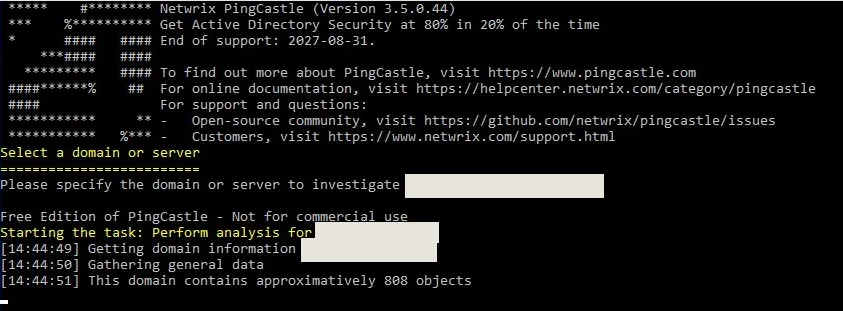
An 808-object Active Directory that had never been audited: a PingCastle score of 100/100, the worst possible, and no test environment.
I ranked the findings by real-world risk and fixed them in production: SMBv1, krbtgt, NTLMv1, privileged accounts and 169 stale objects.
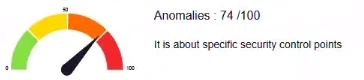
“Anomalies” score down from 100 to 74, 169 stale objects deleted, SMBv1 removed from the controller and existing Golden Tickets invalidated, with no unplanned downtime.
Context
The directory had been created with the company and never audited since. It held 808 objects for about twenty real users: former employees, machines that no longer existed, leftovers from an Exchange server migrated to Microsoft 365.
Two constraints: no test environment, so every command ran on the production controllers; and no unannounced downtime, with management sign-off for any change to an account.
What I did
- Measure, then prioritiseFirst PingCastle scan: 100/100 in three of the four categories. I ranked the findings by what an attacker could do with them, not only by points.
- Remove SMBv1 without breaking anythingFive days of SMBv1 access auditing: none. Disabled, uninstalled, then the primary controller rebooted while the second one handled authentication.
- Rotate krbtgt twiceIts password had not changed in 11 years: a Golden Ticket forged during that time was still valid. Two rotations five days apart invalidate it.
- Clean up accounts without deleting directlyEach object was disabled, moved to a “Quarantine” OU, observed, and only then deleted: 100 computers and 69 accounts in total.
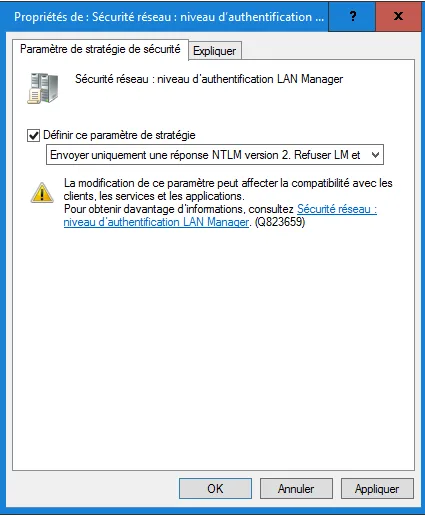
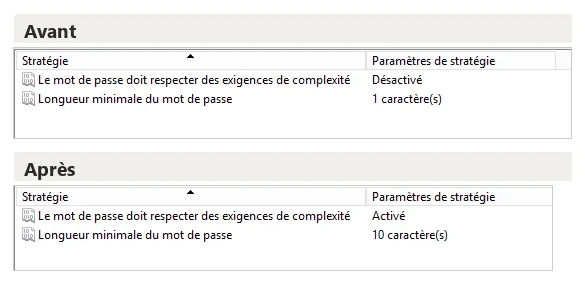
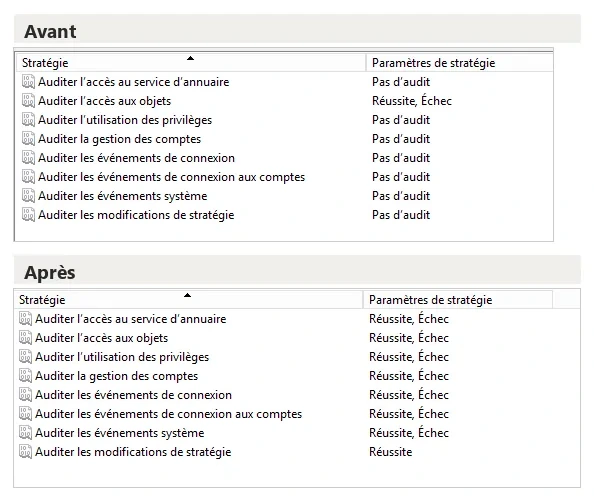
- Close weak access pathsNTLMv1 and LM refused by GPO, 11 admin accounts protected against delegation, minimum password length raised from 1 to 10 characters, advanced auditing sent to the Wazuh SIEM.
See technical details
| Initial finding | Risk | Points |
|---|---|---|
| SMBv1 enabled on the domain controller | Unauthenticated remote code execution (EternalBlue) | 100 |
| krbtgt unchanged for 4,019 days | Golden Tickets still valid | 50 |
| 74% of computer accounts inactive | Reusable accounts nobody watches | 30 |
| Administrators without the “sensitive account” flag | Credential theft through Kerberos delegation | 20 |
| NTLMv1 and LM accepted | Hashes that can be captured and cracked quickly | 15 |
PowerShell · removing SMBv1
# Listen before cutting: who still uses SMBv1?
Set-SmbServerConfiguration -AuditSmb1Access $true -Force
Get-WinEvent -LogName "Microsoft-Windows-SMBServer/Audit" | Where-Object Id -eq 3000

# No access in 5 days: disable, then uninstall
Set-SmbServerConfiguration -EnableSMB1Protocol $false -Force
Disable-WindowsOptionalFeature -Online -FeatureName SMB1Protocol -NoRestart

# After the reboot (the second controller handles authentication):
# force replication to check it resumes without errors
repadmin /syncall /AdeP
PowerShell · quarantine (excerpt)
$quarantaine = "OU=Quarantaine,DC=corp,DC=local"
Import-Csv .\postes_inactifs.csv | ForEach-Object {
    $pc = Get-ADComputer $_.Name
    Disable-ADAccount -Identity $pc
    Move-ADObject -Identity $pc.DistinguishedName -TargetPath $quarantaine
    Add-Content C:\Temp\log_postes.txt "$(Get-Date -Format s);$($pc.Name);quarantaine"
}
| Fix | MITRE ATT&CK technique mitigated |
|---|---|
| SMBv1 uninstalled | T1210 · exploitation of remote services (EternalBlue, MS17-010) |
| Double krbtgt rotation | T1558.001 · Golden Ticket: tickets already forged are invalidated, not those a new theft of the key would allow |
| NTLMv1 and LM refused | T1557 · authentication interception: captured LM and NTLMv1 responses no longer crack in minutes |
| Stale accounts deleted | T1078 · valid accounts: fewer dormant accounts to hijack |
| MachineAccountQuota set to 0 | T1136.002 · domain account creation (computer accounts) |
The incident
A privileged account can no longer log in remotely
A few minutes after their account was added to the Protected Users group, their remote desktop connection was refused.
Removed from the group, delegation reset, session fully closed: access restored the same day. Since then, I test every addition on a non-critical account with the same usage, and I warn the user beforehand.
Results
At the last scan, in August 2026, SMBv1 was uninstalled, the krbtgt password was less than ten days old, LM and NTLMv1 were refused, and a standard user could no longer join a machine to the domain. Work that required a maintenance window was handed to management as a roadmap.
What I would improve
- Enable the Active Directory Recycle Bin and back up the controllers' system state before any deletion.
- Use Microsoft's krbtgt reset script, which checks replication between each step.
- Aim for a 12-character minimum, as recommended by ANSSI (the French cybersecurity agency), and deploy advanced auditing through GPO.